It’s difficult to turn a corner in Tokyo and not find a temple or shrine.
As a refresher, temples are Buddhist while shrines are Shinto.
Most of you have some familiarity with Buddhism, but likely haven’t had any exposure to Shinto.
Shinto is basically the national religion of a country that isn’t very religious. It’s the indigenous religion acknowledging the kami, or spirits, in all natural and ancestral things, and more recently, artificial things. It has existed in Japan long before the introduction of Buddhism. And Christianity.
That’s the nutshell version. Way too short, but if you want to know more, there are plenty of online resources.
In our immediate vicinity, as in the surrounding few blocks or less than a five minute walk, there are no fewer than seven temples and three shrines. Each has a unique character and purpose.
Here are just a few that we’ve run across since we arrived. Starting with the neighborhood.
Riako-ji Temple, Babaschitacho, Shinjuku, Tokyo, JapanRiako-ji Temple, Babaschitacho, Shinjuku, Tokyo, JapanEach temple is the entry portal to a cemetery. To the left, the Fujita Family Grave (yes, that’s exactly what the headstone says) holds the cremated remains of ancestors. And if it doesn’t, it’s still a spot to gather and honor the ancestors.
Speaking of, here’s a more high tech version —
Koukoku-ji Temple, Haramachi, Shinjuku, Tokyo, JapanKoukoku-ji Temple, Haramachi, Shinjuku, Tokyo, Japan. There are 2,046 miniature Buddhas along the walls, each sitting atop a drawer with the ashes of a deceased. We paid to enter and watched the show including all of the Buddha. When a family member arrives to pay their respects, only the Buddha sitting on top of their family ashes is illuminated.
And sometimes shrines exist to assist with more material concerns —
Horoku Inari Shrine, Haramachi, Shinjuku, Tokyo, Japan. This neighborhood shrine is focused on better luck in an interesting way. Visitors deposit their failed lottery tickets and pray for better luck. After the tickets are collected for a year, the deposited tickets are dedicated to the Inari Ōkami, the kami of foxes, fertility, rice, tea, sake, and, most relevant, prosperity. You can see a pair of fox statues at the entrance to the shrine.
Inari will feature again in a bit.
Whenever I roam the grounds of a temple or shrine, I enjoy focusing on the details. There are so many treats to be found.
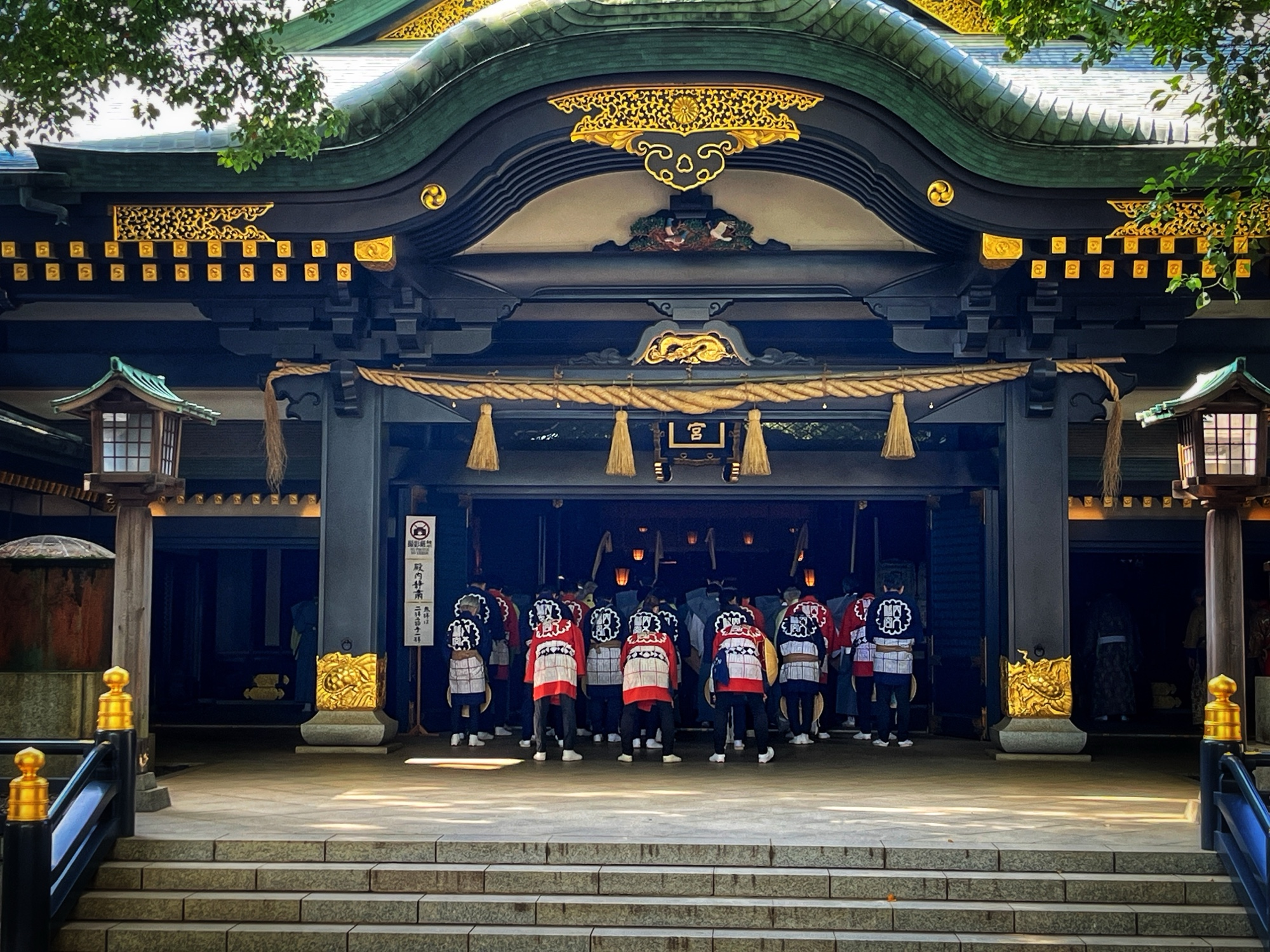
Meiji Shrine, Yoyogikamizonocho, Shibuya, Tokyo, Japan. Although this shrine has historically been one of my favorite places in Tokyo to hang out and watch people, we didn’t have plans to visit. But we found ourselves south of the area and decided to take the long walk back to the room, which was to the north. We were shocked by how crowded it was on a weekday afternoon, more so than the weekend days that we remember. So we walked through relatively quickly and headed on our way.Ana Hachimangu Shrine, Nishiwaseda, Shinjuku, Tokyo, Japan. We stumbled across this shrine while expanding our circle of exploration outside the neighborhood. Little did we know that we would be back a week later to see the prayers for and procession of the participants in a traditional horseback archery competition (more on that in a later post).
Further afoot, our roaming took us to other temples or shrines.
Yasukini Jinja (Peaceful Country Shrine), Kidankita, Chiyoda, Tokyo, Japan. Dedicated by Emperor Meiji in 1869, the War Memorial has the detailed records of over 2 million individuals who died in service to the Emperor and Japan since 1868.Yasukini Jinja (Peaceful Country Shrine), Kidankita, Chiyoda, Tokyo, One of several doors at the gate to the War Memorial. This doesn’t convey the size. It’s about 30 feet tall, 8 feet wide, and 1.5 feet thick. The stylized chrysanthemum, signifying the Showa Emperor’s reign (1926-1989) is about 4 feet in diameter. Sengaku-ji Temple, Takanaka, Minato, Tokyo, Japan. This temple was founded in 1612 by the Shogun Tokugawa Ieyasu. It’s most famous now for the gravesites of the 47 Ronin. Read that wiki link if you aren’t familiar with a widely recognized and revered series of events in 1703.Akō Forty-Seven Ronin Cemetery. Sengaku-ji Temple, Takanawa, Minato, Tokyo. Japan. Payment to the cemetery bought a bundle of lit incense which were to be placed at each headstone. As the place filled with visitors, the smoke from the offered incense became overwhelming, a strong reminder of the importance of the event in the national psyche and popular culture.Akō Forty-Seven Ronin Cemetery. Sengaku-ji Temple, Takanawa, Minato, Tokyo. Japan. To date, 12 films have been made worldwide about the events of the Akō vendetta. To the Japanese, it’s an example of bushidō, the Samurai code of conduct exemplifying loyalty, honor, persistence, and sacrifice. By placing the incense blocks low, everyone must bow before most of the headstones to place the incense (as seen above).
A not-so-short walk later (it was an 11-ish mile day) —
Zojo-ji Temple and Tokyo Tower, Shibakoen, Minato, Tokyo, Japan. The temple is noted for its association with the Tokugawa clan, which ruled Japan from 1603-1868, for better and for worse. Six of the Shoguns (Commander-in-Chief of Expelling the Barbarians) of that clan are buried here, although we couldn’t access that portion of the grounds on the day that we visited. No matter, as the real purpose for our visit was —Sentai Kosodate Jizō (Unborn Children Garden), Zojo-ji Temple, Shibakoen, Minato, Tokyo, Japan. There are 400 of these Jizō, the guardian of unborn children. Traditional garb is to the right, with a red bib and cap. Red is to ward off evil, while the bib signifies infancy and the cap is to keep the child warm in the afterlife.Sentai Kosodate Jizō (Unborn Children Garden), Zojo-ji Temple, Shibakoen, Minato, Tokyo, Japan. These two non-traditional outfits were a pleasant surprise in an otherwise somber visit. You’ll see more of these in upcoming posts, because they are so meaningful.I couldn’t resist. Here’s a typical midday attempt at taking pictures of a temple or shrine. Everyone in front is in the frame of that camera, the two outer folks are just the icing on the cake. No worries, as I have old school ways of making them disappear as I capture the image that I want. For you geeks out there, it’s a 10-stop Neutral Density filter at 25+ second exposures. They just need to be moving during that time. No Photoshop required.Shinkokyo-in Temple, Higashiazabu, Minato, Tokyo, Japan. Just a great juxtaposition of old and new. Thankfully the dark clouds were departing. It had just rained.Juban-Inari shrine, Azabu-juban, Minato, Tokyo. Popular with the kids, these statues refer to an old story of the area when a fire swept through, burning most of the buildings, a frog stood in front of the only building that didn’t burn.Juban-Inari shrine, Azabu-juban, Minato, Tokyo. This statue depicts the “Minato (city) Seven Lucky Gods,” which ties in with Inari, the god of fortune mentioned above. They each preside over professions or the arts.
Lastly, we return to the neighborhood, just a 2-minute walk from where we are staying.
Mizuko, Kyoo-ji Temple, Haramachi, Shinjuku. Similar to the jizō found at Zojo-ji above, the statue depicts Mizuko (Water Child) being welcomed into the afterlife.Mizuko, Kyoo-ji Temple, Haramachi, Shinjuku. Seeing Mizuko from a different angle, you can see the offerings left by family members for the unborn children to enjoy in the afterlife. The white sign to the right warns people to not leave food offerings at the statue, but to instead take them inside. Crows make a mess, apparently.Survivor tree. Kyoo-ji Temple, Haramachi, Shinjuku. The tall persimmon tree, just left of center frame, grew from seeds of a tree located just 0.8km (0.5 miles) from the hypocenter (ground zero) in Hiroshima. It’s one of two in this cemetery.Ancient ginkgo tree. Koukoku-ji Temple, Haramachi, Shinjuku, Tokyo, Japan. Back to the temple of illuminated buddhas, another fine surprise was two ancient ginkgo trees, estimated to be 500-600 years old. They are registered as trees of natural importance. In the Shinto tradition, they are recognized as sacred trees (goshinboku) and as paths for the kami (gods) to return to earth. The goshinboku are designated with the white ribbons wrapped around the trunk. They will be astounding in a few weeks when the leaves change.
But it’s not all temples. It’s festival season, too. But that’s for another post. Perhaps in few days.
Like this:
LikeLoading…
Comments
4 responses
KW
Very Interesting and Very Cool! These pictures are great.
I really enjoyed discovering the trees on this segment. Seeing the ancient trees and what their meanings are. Not included, but in addition to is Grant’s Pine at Zojo-ji.
Also, thank you for the introduction on the 47 Ronin. Such a fascinating story.



Leave a Reply