
Two+ weeks in Tokyo went way too fast. There is so much there that we need to see. But Tokyo isn’t all there is to Japan.
It was time for us to move on and experience parts of the country that we haven’t before. And we wanted to do it in ways that we hadn’t before.
We could have hopped on the Shinkansen (Bullet Train), grabbed a flight, or rented a car. While all are varying degrees of expensive (driving the most), since we aren’t on a tight itinerary like a 7- or 10-day visit, our goal is to travel slow when possible. So we did.
A few years ago, I ran across a video channel on YouTube where the guy travels Japan by ferry and describes the voyage with simple ambient sounds and English subtitles. The episode that caught my attention was the route connecting Tokyo with the two major islands of south and west Japan, Shikoku and Kyushu, neither of which we had been.
I was going to embed the video, but that doesn’t seem to be working right. So here’s the url, if you’re interested. It’s a 20-minute watch at normal speed. You’ll just have to copy/paste into your browser — https://youtu.be/me8qgPNiZ-E

Here’s the standard route map, screen captured from the video.
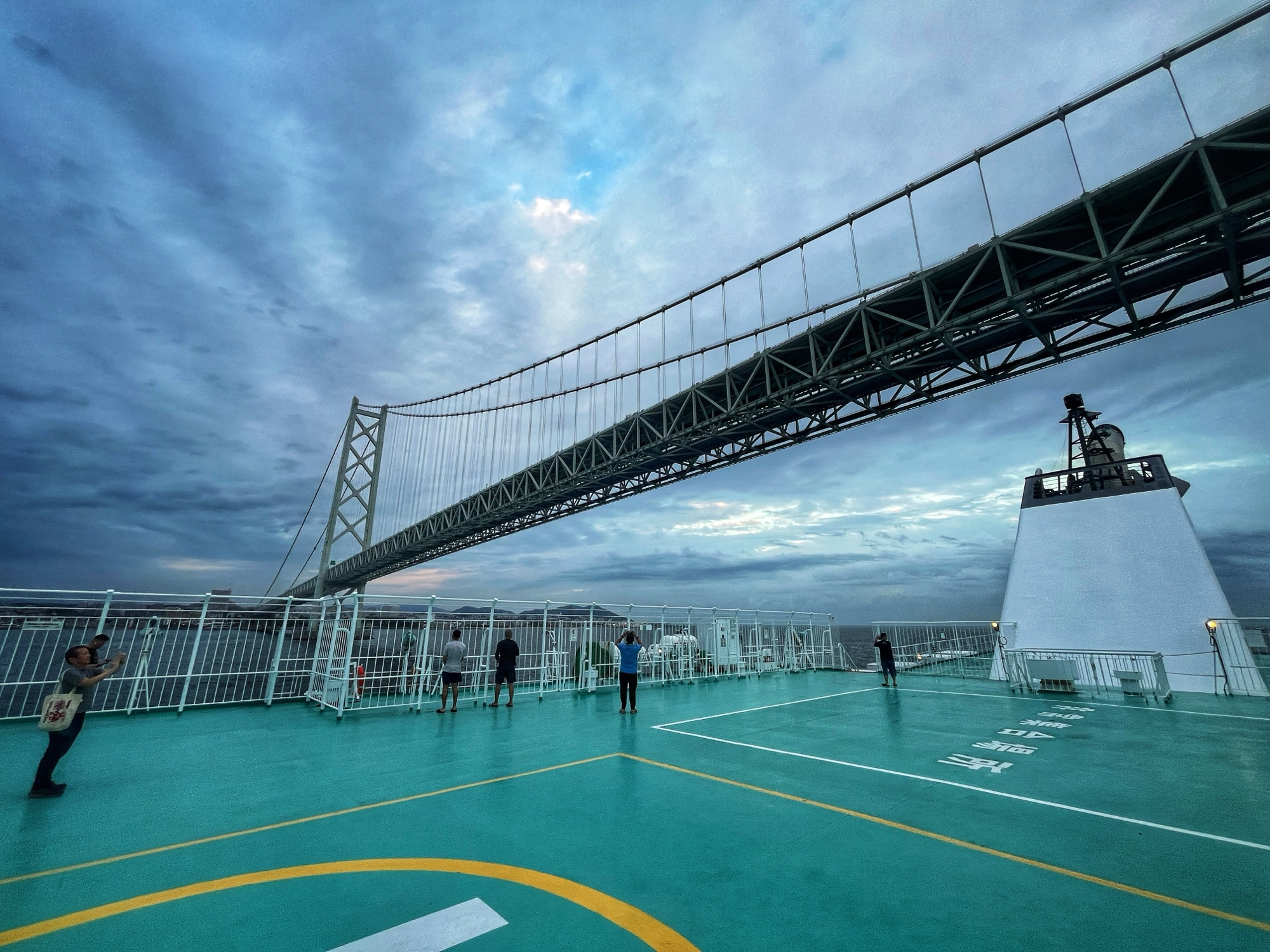
After good-byes to 日本の女神 (Japanese Goddess) and our German friends, we set sail at 7pm, which gave us a great nighttime view of the city. A bit over an hour later, we were passing under the Tokyo Bay Aqua Line, a 24km (15mi) long structure that connects the two sides of the massive bay from Kawasaki to Chiba Peninsula. Without it, travel across would either be by ferry or an all-day drive up and around.
I tried uploading our video, but it kept failing. So you’d really just have to watch the video above, although ours will end up on Instagram after this post goes live.
By about 10pm, as we left the mouth of Tokyo Bay, we started to feel the effects of Super Typhoon Champi, the 30th storm of the 2016 season. While the Atlantic has been quiet, the western Pacific has not.
Champi was several hundred miles to our south, but the swell was already reaching Japan. And its forecast track was painting a bullseye on our destination, Fukuoka. Because why not?

By then, we settled into our room, built for four, which was the only one available when 日本の女神 (Japanese Goddess) booked it for us. The company solely spoke Japanese from beginning to end.

Overnight, the swell increased. Thankfully it was abeam, so we just had a heavy rolling motion, as the ship was quite a bit smaller than the trans-Pacific cruise liner. That swell made it tough to sleep and walk, but it’s nowhere near as rough as if the swell approached head on. By the time we woke up the next morning, I had concerns about the second leg of the trip, from Shikoku to Kyushu. The storm had been rapidly intensifying for days, which could only mean a larger swell.
The quality and variety of food available from the vending machines was quite good. There was hot and cold water and tea on offer, plus a few vending machines of beverage, leaded and unleaded.
For the first leg, there was one other gaijin (foreigner) couple, but they disembarked in Shikoku, leaving only us for the remainder of the trip. No worries, as the translation technology is so good now. We try our best with the reading and speaking, but there are limits.
Once the limit is reached, we grab our phone. We can either speak into our phone or have the staff member speak and the transcription is almost instantaneous. For advisory bulletins or menus, we just take a picture, then tell the app what languages. It’s almost instantaneous, too. This capability has completely changed travel compared to 20+ years ago.
We don’t feel like we are completely clueless, now.
Another huge advance is luggage forwarding services. The day before we left Tokyo, we rolled our suitcases down to the closest conbini (convenience store like 7-11, Family Mart, etc.) and checked in our bags. For about $14 each, our suitcases beat us to Fukuoka. And we didn’t have to cart them through train stations, which is a significant advantage, especially during busy times or tight connections. We just traveled with our carry-on bags. Light and quick.
Back to the ferry, we entered the protected waters as we approached the port of Tokushima, Shikoku. That meant that the swell subsided, but we got to experience a sweltering record breaking high temperature for the area, with Osaka, just across the bay, hitting 86F with a relative humidity of 65%.
Did I say sweltering?
We were only in port an hour, which was plenty of time to unload all of the passengers, autos, and trucks held down below, then reverse the process so we could get underway. Only an hour! It was quite a process.
Not soon after getting underway, I noticed that we weren’t heading south to continue our voyage in the open Pacific. Instead, we turned northwest towards Osaka/Kobe, then turned west to traverse the Inland Sea towards Kyushu. Shikoku would shield us from the increasing swell!

That was a great time to take advantage of the onboard onsen (deep hot bath). His and hers separate facilities, early enough in the day that there were only a handful of people. And a few minutes to sit up to my neck in hot water without touching a side of the tub. It was glorious to not be crammed into a tub where, if I wanted water up to my neck, that meant that my knees were a foot above the water line.
Civilized.
Ideally, the hot bath, dinner, and no swell would mean better sleep. But the 5:30am port arrival the next morning meant a 4am alarm. Which meant that both of us were wide awake at 2am. That’s pretty typical for us on a travel day. We don’t worry about it. We just go.
Right on time at 5:30am they had us disembark. No dilly-dallying. We had arranged a taxi to get us to the train station, which would have otherwise been an hours-long walk from the port. Even the closest bus stop to the port, which would still take us to the train station, was almost an hour-long walk.
The ¥500 ($3.20) each was worth it.
We pulled up our train options to get to Fukuoka. We could hop on the Shinkansen and get to Fukuoka in 30 minutes. Or we could hop on the Rapid (skips a bunch of stations along the way), which would take just over 90 minutes, for about a tenth of the price. Since it was 6am and we couldn’t check in to our hotel until 3pm, it was an easy choice.
The third option was to take a local train, which meant that it stopped at every single station along the way, which would add a half hour to the trip for minimal savings. We’re all about the slow travel, but not abuse. So went spent just a bit more to stop at only 16 stations vs 29 stations. Well worth it.
Our station (Moji) was the start of the line, so we easily grabbed seats. As we got closer to Fukuoka, the train became crowded with commuters on their way to school or work. Packed, not as bad as Shinjuku, but packed.
Once we arrived at Hakata Station, the main station for Fukuoka, at 8am, we found a locker and stashed away our carry-ons for the day.
Then we were off to explore Fukuoka.
With Champi breathing down our necks.

Addendum – for those of you wondering, a Shinkansen ride would have taken just 5 hrs at approximately ¥48,000 ($306) total. The ferry, on the other hand, was about ¥63,000 ($400), but that included two nights room. Those two extra nights in Fukuoka would have made the Shinkansen the more expensive option, unless we were on a tight schedule.
What would your preferred experience be? Quick, easy, and more expensive? Or slower, a bit more complicated, and cheaper (maybe, depending on time calculations)?

Leave a Reply